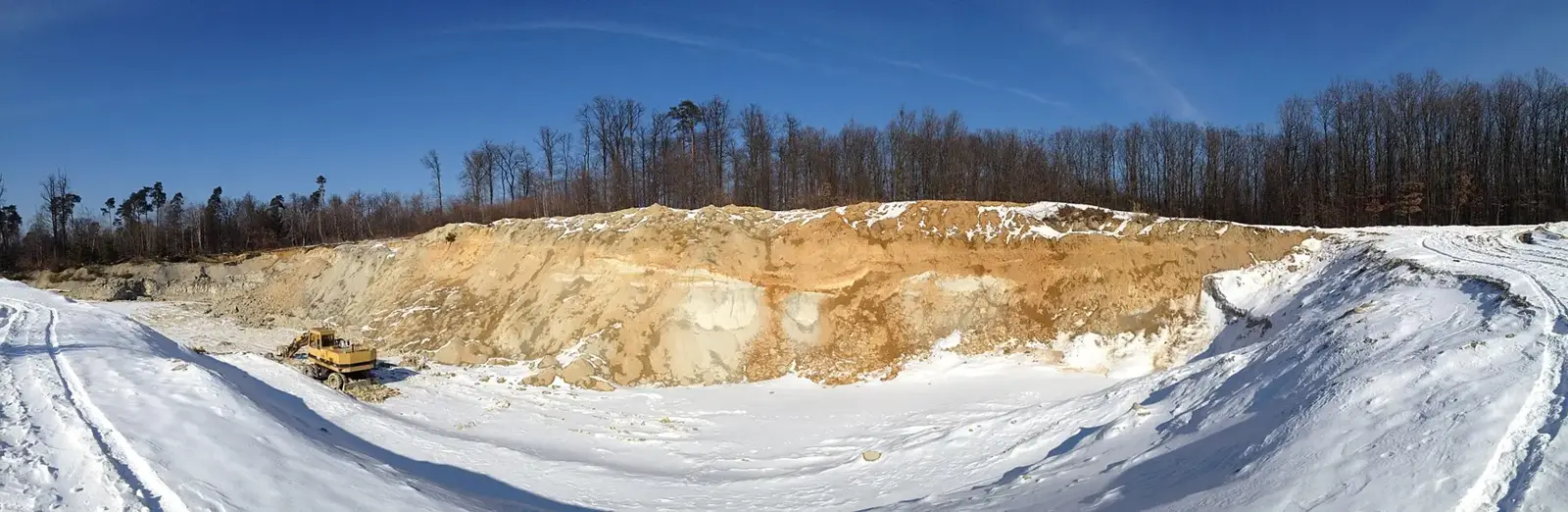
Why crude kaolin has to be purified
Kaolin is mined as a clay-rich ore, not as a finished powder. Besides kaolinite (Al₂Si₂O₅(OH)₄), the ore usually contains free quartz sand, mica, feldspar, and small amounts of iron oxides, iron hydroxides, pyrite and titanium minerals such as anatase. Each of these has a visible or measurable effect on the end use:
- Coarse quartz and mica raise the 325-mesh residue, scratch paper blades and leave specks in ceramic glazes.
- Iron minerals turn kaolin cream, yellow or brown, and show up as dark spots or a tinted body after firing.
- Titanium minerals reduce brightness and push the colour towards grey or yellow.
- Wide particle size distribution makes viscosity, gloss, and opacity hard to control.
Purification does not change the nature of kaolinite itself; it removes what is mixed in with it and narrows the particle size range.
The wet-processing route, step by step
High-whiteness industrial kaolin is usually produced by a wet route. The exact flow sheet depends on the ore and the target grade; the sequence below is typical.
| Step | What it does | What it mainly removes or controls |
|---|---|---|
| 1. Selective mining and blending | Ore from different benches is separated by quality and blended | Starting whiteness and impurity level of the feed |
| 2. Blunging | Crude clay is dispersed in water with a dispersant to form a slurry | Breaks up clay lumps so impurities can be liberated |
| 3. Degritting | Screens, sand traps and hydrocyclones | Quartz sand, coarse mica, feldspar and rock fragments |
| 4. Classification | Hydrocyclones or centrifuges split the slurry by particle size | Coarse fraction; sets D50 and % < 2 µm |
| 5. Magnetic separation | High-intensity, high-gradient magnetic field acting on the slurry | Weakly magnetic iron- and titanium-bearing minerals |
| 6. Chemical bleaching (where needed) | Reductive leaching, for example with a dithionite-type reagent, then washing | Fine iron oxide staining that is not captured magnetically |
| 7. Dewatering | Flocculation, filter pressing or similar | Water, soluble salts carried in the slurry |
| 8. Drying and milling; optional calcination | Spray or flash drying; heating for calcined grades | Moisture; combined water and organic matter in calcined grades |
Some producers use a dry route instead — crushing, drying, pulverising and air classification. It is simpler and lower in cost, but it generally removes less of the discolouring impurities than the wet route, which is why high-whiteness grades for coating, ceramics and catalysts are normally wet-processed.
Which impurity is removed by which step
| Impurity | Effect on the product | Main removal method |
|---|---|---|
| Free quartz / sand | Abrasion, higher residue, higher SiO₂ | Degritting, hydrocyclones, screens |
| Mica and feldspar | Higher alkalis (K₂O, Na₂O), grit | Classification, screens |
| Hematite, goethite, limonite, siderite, pyrite | Yellow to brown colour; fired spots; lower brightness | Magnetic separation, bleaching |
| Titanium minerals (e.g. anatase) | Lower brightness, grey-yellow tone | Partly by magnetic separation when iron-bearing; otherwise controlled mainly by ore selection |
| Organic matter | Grey tone | Oxidative treatment, or calcination |
Some discolouration cannot be removed physically: iron substituted inside the kaolinite crystal structure, for example, stays with the clay. This is why the starting ore sets a ceiling on achievable whiteness, and why ore selection matters as much as the equipment.
How purification appears in a specification
A buyer sees the result of purification through a handful of numbers: Fe₂O₃ and TiO₂ (colouring oxides), whiteness or ISO brightness, % < 2 µm and D50 (fineness), and 325-mesh residue (grit). Removing free quartz also moves the chemistry slightly: SiO₂ goes down and Al₂O₃ goes up towards the theoretical kaolinite composition of about 39.5 % Al₂O₃, 46.5 % SiO₂ and 14 % combined water.
See how to read a kaolin specification sheet and the typical reference values for each PTMS grade.
Our approach
FOSHAN POWTECH TECHNOLOGY COMPANY LIMITED designs and manufactures PTMS electromagnetic and high-gradient magnetic separators for kaolin and other non-metallic minerals, and applies this magnetic purification step to its own kaolin. Read the details on iron removal with an electromagnetic slurry magnetic separator, or build your specification and request a sample.
Frequently asked questions
Can any kaolin be purified to high whiteness?
No. Purification removes mixed-in impurities, but the ceiling depends on the ore. Colour caused by iron inside the kaolinite structure, or by very fine titanium minerals, is hard to remove physically, so some ores never reach paper-coating whiteness.
What is the difference between wet and dry processing of kaolin?
Wet processing slurries the clay and removes grit, coarse minerals and iron-bearing impurities with hydrocyclones, magnetic separators and sometimes bleaching. Dry processing crushes, dries and air-classifies the clay. Wet processing usually gives higher whiteness and a tighter particle size distribution.
Does purification change the chemical composition of kaolin?
Slightly. Removing free quartz lowers SiO₂ and raises Al₂O₃, and removing iron and titanium minerals lowers Fe₂O₃ and TiO₂. The kaolinite itself is not altered unless the clay is calcined.
Related guides
Need a sample or a quote?
Free samples available on request. Build your spec in two minutes and send it via WhatsApp or email.
Published: · Updated: