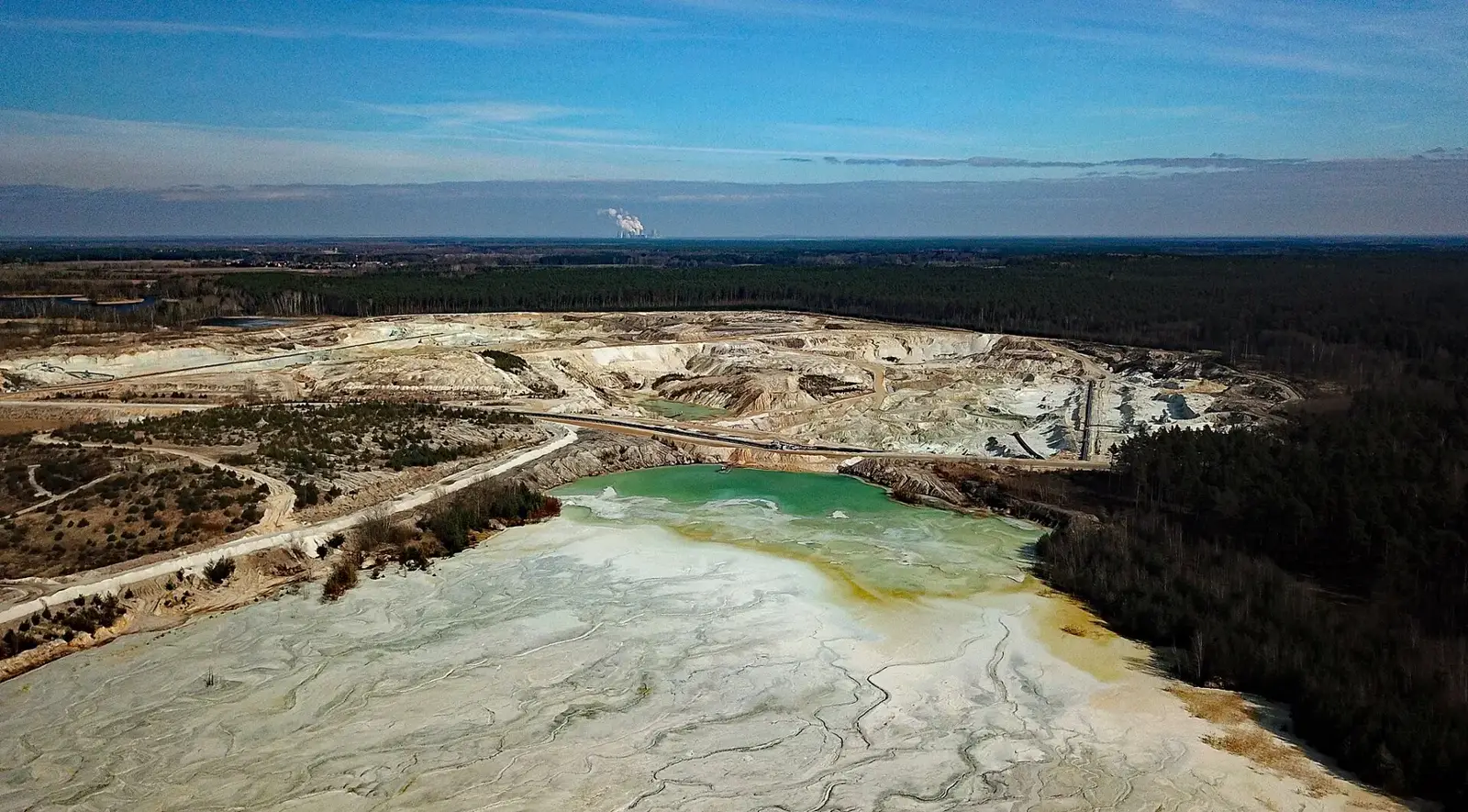
Why iron matters in kaolin
Iron is the most common colouring impurity in kaolin. Even a fraction of a percent of Fe₂O₃ can give the clay a cream or yellow tint, and after firing it appears as a tinted body, brown specks or dark spots in ceramics. In paper it lowers brightness, in fiberglass it affects glass colour, and in catalysts it counts as a metal contaminant. For this reason Fe₂O₃ is one of the first lines of almost every kaolin specification.
What kind of iron is in the clay
Kaolin typically carries iron as discrete fine minerals — hematite, goethite, limonite, siderite and pyrite — plus iron-bearing titanium minerals, and a smaller part as stains on particle surfaces or inside the kaolinite lattice. Most of these minerals are weakly magnetic (paramagnetic or weakly ferromagnetic). A simple permanent magnet or rod magnet picks up strongly magnetic tramp iron and magnetite, but it does not capture these fine, weakly magnetic particles. They need a strong magnetic field combined with a high field gradient.
How a slurry magnetic separator works
- Slurry preparation. The kaolin is dispersed in water and degritted, so that coarse particles do not block the machine.
- Magnetised matrix. The slurry flows upward or downward through a separation chamber filled with a magnetic matrix, for example stainless steel wool, expanded metal or rods. An electromagnet coil magnetises the matrix.
- Capture. The matrix wires concentrate the field into very high local gradients. Weakly magnetic particles are pulled onto the wire surfaces, while non-magnetic kaolin passes through as purified slurry.
- Flushing. When the matrix is loaded, feed is stopped, the coil current is switched off, and the matrix is flushed with water to wash the captured iron minerals out. The cycle then restarts.
This approach is known as high-gradient magnetic separation (HGMS) and has been used for kaolin beneficiation since the 1970s. With an electromagnet the field strength is set by the coil current and can be switched off completely for flushing, which keeps cleaning simple and the field adjustable to the ore.
Operating variables that decide the result
| Variable | Why it matters |
|---|---|
| Field intensity | Weakly magnetic minerals need a high field — in the order of a tesla or higher for kaolin. A higher field captures finer and less magnetic particles. |
| Matrix type and packing | Finer wire gives higher gradient and better capture of fine particles, but is easier to block. Coarse grit must be removed first. |
| Flow rate / residence time | Slower flow through the matrix gives particles more time to be captured; faster flow raises throughput but may reduce Fe₂O₃ removal. |
| Slurry dispersion and solids | Well-dispersed slurry at a moderate solids content lets iron particles reach the matrix; flocculated or very thick slurry traps iron inside kaolin flocs. |
| Feed particle size | Degritted, classified feed protects the matrix and improves the selectivity of capture. |
| Cycle time and flushing | Flushing before the matrix is overloaded keeps capture efficiency stable and limits breakthrough. |
Where it sits in the flow sheet
Magnetic separation normally follows blunging, degritting and classification, and comes before chemical bleaching and dewatering. Removing the discrete iron minerals physically first means less bleaching reagent is needed for the remaining fine iron staining. See the full purification route.
What it can and cannot do
- Can: lower Fe₂O₃ and TiO₂ that sit in discrete weakly magnetic particles, and raise whiteness or brightness accordingly.
- Cannot: remove iron built into the kaolinite structure or dissolved iron — those need ore selection or chemical bleaching.
- Trade-off: some fine kaolin is entrained with the captured fraction, so yield and iron removal are balanced during testing.
- Ore-dependent: the whiteness gain depends on how much of the colour comes from magnetic minerals; it is measured on a sample rather than assumed.
Testing the result
A bench or pilot test normally compares feed and product for Fe₂O₃ and TiO₂ by XRF, brightness or whiteness (and fired whiteness for ceramic grades), and the mass yield of the non-magnetic product. Repeating the test at two or three field settings and flow rates shows where the best balance lies for a given ore.
Our equipment and kaolin
FOSHAN POWTECH TECHNOLOGY COMPANY LIMITED builds PTMS electromagnetic and high-gradient magnetic separators for kaolin, feldspar, quartz and other non-metallic minerals — see www.powtechina.com. PTMS kaolin is purified with the same technology. For iron-sensitive uses, look at the low-iron kaolin page or specify your own Fe₂O₃ limit.
Frequently asked questions
Is a permanent magnet enough to remove iron from kaolin?
A permanent magnet or magnetic rod is useful as a guard against tramp iron and strongly magnetic particles. The colouring minerals in kaolin are weakly magnetic, so a high-intensity, high-gradient electromagnetic separator is used for them.
Can magnetic separation replace chemical bleaching?
Not always. Magnetic separation removes discrete iron minerals; bleaching dissolves fine iron staining that magnets cannot capture. Many high-whiteness flow sheets use magnetic separation first and bleaching second to reduce reagent use.
Does the magnetic separator remove kaolin together with the iron?
A small amount of fine kaolin can be entrained in the captured fraction. Flow rate, matrix choice and flushing are tuned so the iron removed is balanced against the kaolin recovered.
How do I know how much iron can be removed from my ore?
Only a test on a representative sample shows it. Compare Fe₂O₃, TiO₂, brightness and yield before and after separation at several settings.
Related guides
Need a sample or a quote?
Free samples available on request. Build your spec in two minutes and send it via WhatsApp or email.
Published: · Updated: