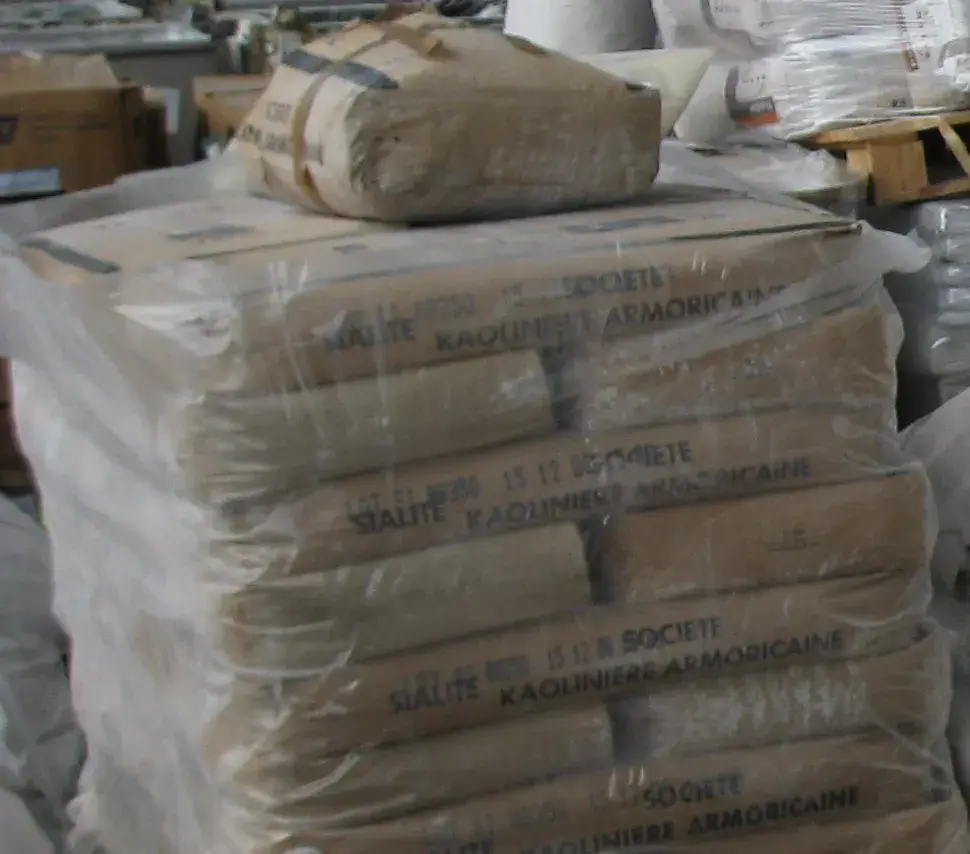
What each one is
Hydrous kaolin (also called washed or processed kaolin) is wet-processed — degritted, classified, purified — and dried, but not heated enough to change the crystal. It stays kaolinite, Al₂Si₂O₅(OH)₄, with about 14 % chemically combined water.
Calcined kaolin is hydrous kaolin heated further. Between roughly 450 and 600 °C the structure begins to lose its hydroxyl water and becomes metakaolin; at higher temperatures, around 1000 °C and above, it reorganises into a hard, stable, low-water product. The temperature and time used set the properties of the grade.
Side-by-side comparison
| Property | Hydrous (washed) kaolin | Calcined kaolin |
|---|---|---|
| Loss on ignition (LOI) | About 13–14 % | Very low once fully calcined |
| Brightness / whiteness | High | Higher — calcination removes organic matter and adds light-scattering structure |
| Opacity (light scattering) | Moderate | Higher, so it can extend TiO₂ in paint |
| Oil absorption | Lower | Higher |
| Abrasion | Lower | Higher (harder particles) |
| Plasticity | Plastic; gives green strength in ceramics | Non-plastic |
| Electrical insulation | Adequate for general use | Often preferred for cable and insulation compounds |
| Relative cost | Lower | Higher — calcination uses energy |
Qualitative comparison. Numerical values depend on ore, process and grade and are agreed per order.
Where each is used
- Hydrous: ceramic bodies and glazes, paper filling and coating, rubber and general fillers, paint extender where cost matters.
- Calcined: architectural and industrial paint (partial TiO₂ replacement, opacity), plastics and cable compounds, paper coating where opacity and bulk are needed.
- Metakaolin (calcined at lower temperature) is a different product, used mainly as a supplementary cementitious material.
See our pages on washed / hydrous kaolin, calcined kaolin and filler kaolin.
How to choose
- If your process relies on plasticity, casting behaviour or low abrasion (ceramics, paper machines, rubber processing), start with hydrous.
- If you need maximum whiteness, opacity or oil absorption (paint, plastics, coatings), evaluate calcined.
- If you are unsure, test both — request samples of each and compare them in your own formulation.
Use the Spec Builder to set your target values and request samples of both.
Frequently asked questions
What is LOI and why does it differ between hydrous and calcined kaolin?
Loss on ignition is the weight lost when a sample is heated to a high test temperature. Hydrous kaolin loses its chemically combined water, about 13–14 % of its weight. Calcined kaolin has already lost that water, so its LOI is very low.
Is calcined kaolin the same as metakaolin?
Not exactly. Metakaolin is kaolin heated at a lower temperature to an amorphous, reactive state, mostly used in cementitious systems. Fully calcined kaolin for paint and plastics is heated much higher to give a stable, bright, low-water product.
Can I substitute calcined kaolin for hydrous kaolin in my formulation?
Usually not one for one. Oil absorption, abrasion, rheology and opacity differ, so the formulation needs to be re-tested. Compare samples before changing.
Related guides
Need a sample or a quote?
Free samples available on request. Build your spec in two minutes and send it via WhatsApp or email.
Published: · Updated: